Showing posts with label Los Angeles. Show all posts

L.A. Louver: First Library on the Art Library Crawl


I just found this post hidden in my drafts! This Archive was the first visit on the Art Library Crawl project. I am pleased to show it the light, at last.


I was thrilled to visit L.A. Louver. This significant commercial gallery, founded in 1975, has wooed me from afar with its tantalising mailouts for some time from far across the pond.
I love the feel of the structure, designed by Frederick Fisher in 1997.


Its walls support an impressive program of contemporary local and international work, the gallery stable including David Hockney, Leon Kossoff, Alice Neel, Sean Scully, Tony Bevan and Fred Williams.

I meet the archivist Alice serendipitously in the goods lift [...seeing art with small children in strollers often affords you a look behind the scenes. One ends up in enormous elevators designed for the largest format artworks, which to me causes an enticing sense of shifted proportion]. Alice generously agrees to meet with me the next day (sans children) for a quick chat about her role at the gallery.


Here is Alice amongst the main archives. While I can sympathise with the sense of exposure experienced by an archivist trying to (neatly) manage her workload in full view of patrons, as a patron (and affirmed library stickybeak), I love the glimpse that this design provides into the inner workings of the organisation's information backbone.


Here it is peeking out -neatly- from behind the velvet rope in the upstairs exhibition space. It is shown here framed by the works of Rebecca Campbell.
The shelves on the right contain the physical files, publications and ephemera of the exhibition files, and the shelves on the left contain artist files. Digital archiving is done with Filemaker.


The gallery website provides easy access to their past exhibitions online under 'then', back to 2003. Alice is currently in the process of digitising and publishing the full back catalogue, encompassing the entire exhibition history since the gallery's establishment in 1975. Already the gallery's online presence is meaty. Current and future exhibitions are at 'NOW' and 'next'. These locations also contain generous links to respective current and upcoming shows for their represented artists at other galleries.


The gallery's programs and energetic record keeping has made its archives an important repository for curators and artists over the years.


Gallery Director Kimberly Davis filled me in while I photograph her with her monographs on contemporary artists [in her office here with works by Ben Jackel and Don Suggs].

She expressed pride in the gallery's library and archive. She explains that the organisation spends a lot of time, energy and resources to make it available- both internally and externally. They regularly accomodate a range of scholars and curators from around the world. This patronage reaches far beyond the artists they are involved with. Counting the monographs in her office (as well as co-Director Peter Goulds collection), the gallery maintains a reasonable general library. However, for the artists L.A. Louver represents -such as Hockney and Kossoff- their archive is almost a complete record of everything they have done, enabling a uniquely full understanding of their work. These artists frequently request from L.A. Louver's archive. In fact, they get requests for info from just about everyone [today they had a curator from Vasser in the gallery doing research].
While not an educational facility -they are foremost a working gallery- people respectful of this constitution will continue to reap the rewards of this fine fine-art resource.

Art Center College of Design: Exhibition Space


This library exhibition space showcases a regularly rotating display curated mostly by library staff.
It is can be requested for events by faculty and students.


Current exhibit highlights a early Photography Department Chair Charlie Potts

Described as a war hero, this highly regarded educator was a combat photographer during WW2, and shot the Japanese surrender on the USS Missouri.
He then went on to (perhaps even more impressively) teach at the Art Center College of Design for 47 years.
This exhibition was collected and curated by a former student of his James Caccavo, who also went on to include combat photography in an impressive photographic career. Included in this collection of papers, awards and photos are most of the cameras Mr Potts used in his practice.

The submission process for the space is fairly loose with no committee or formal guidelines.
They have never rejected a submission. Exhibitions often link with soft events: talks and presentations in the library of an afternoon during library hours.


There really were broad physical and cultural differences between library exhibiting spaces in the colleges of the US and the Library Stairwell Gallery of the National Art School Library in Sydney.

The Library Stairwell Gallery [LSG] at NAS is the only dedicated student exhibiting space on campus and the opportunity to show there is contested heartily through the year.
The Library Stairwell Gallery Committee is made up of heads and representatives from all departments (Drawing, Art History and Theory, Painting, Sculpture, Photography, Printmaking and Ceramics) as well as the Library, and the exhibitions feed in to professional development aspects of the curriculum.
Shows are mostly curated by students, and the space is managed by Library staff.

Another driving force behind the energy of the NAS LSG exhibition space, I have to admit, is the scope for opening events.
The LSG floor plan is such that the library proper can be locked at closing and the external doors of the exhibiting space swung wide for the opening party, with it's accompanying hors doevres and mediocre wine. This separation, producing a stand-alone gallery within the backbone of the library is invaluable indeed.

Apart from layout, another fortuitous element in the LSG's success are refreshments. With the American drinking age at 21 most college students can't drink- at least not legally, and certainly not on campus.
Many agree there are few better ways to legitimise an exhibition opening as a bona fide event than via a glass of red.
The opportunity to celebrate, and toast, the culmination of producing and curating work, catalogues, invitations, wrangling the hang and planning the bump out is taken seriously by exhibiting LSG artists.
A teeming throng of friends and family, fellow students, alumni and various art-world reprobates and renegades attend.
Lecturing staff spend time socially with their pupils and talk about practice outside the formal teaching/studio setting. With custom and architecture on our side, a fine time is had by all at the Library Stairwell Gallery openings.
Especially by the art-show-butterfly library staff.

Art Center College of Design: ACCD DVD


The ACCD DVD collection is hefty, weighing in with approximately 10,000 titles.
The library also provides acces to a number of film streaming services. These services seem to be much more common in American libraries that in those back in Oz. I'm sure we will get there.

Physical film resources have subject division displayed via coloured spines.
Feature films sport this hot pink.


These instructional Gnomen DVDs are extremely popular resources.ACCD also provides access to an online subscription service of short format software training vids via lynda.com.
Turns out Lynda (of the .com) is a graduate and former ACCD faculty member who developed the project/business with her illustrator husband (also an Art Centre graduate).
lynda.com is currently engaged with creativity on a more conceptual scale, with interviews and documentaries on creatives and their process, a series on colour theory, and other art, design and composition streams.


Workhorse videocassettes sporting white spines 


Other film subject categories include the documentary collection, films about art or artists, animation, history and science, music videos, advertising, television, experimental video art and guest lectures.

Read more about the James Lemont Fogg Library's film collections here.


Art Center College of Design: Archive


The ACCD Archive collects and preserves the historical documents of the school, its alumni and faculty, and its landmark site.
It houses a variety of material: the tree made publications of the institution, books, video, film, audio, photographs and events ephemera.

ACCD Library Director Betsy Galloway supported the relatively recent creation of the archive. With the impetus of a major anniversary of the school (75 years young), a grant was sought and won, with funds used to create the archive and arm it with archiving talent.
Archivist Robert (Bob) Dirig has since help transform the collection from the mildewed boxes of old to the well ordered universe that lay before me.

With a strong background in film preservation, Bob's current role provides a welcome opportunity to work with the various departments, pinning down all kinds of production for the records. He notes the necessity of proper archiving for an institution to really know itself, historically and contemporaneously. Here is a short interview with Bob where he shares his views on archiving, medium, technology and the like.


The space was filled with the customary (and for me, desirable) shelves of the aesthetically calming, repetitive forms of archive boxes in neutral
tones- great.


A handsome timeline displaying images of past Center Presidents collated from the photo archive by Bob himself- excellent. 


But what was truly fantastic for me was one of the jewels of their fine collection- the 1948 Ansel Adams portfolio.


The old library stamps spurred conversation on the chronological/institutional/operational and design issues library stamps can represent.
How different practices and paradigms can be easily read not just in the typography, typeset and ink of the stamp, but in the placement and spread of the marking.
Organisational name changes and library name changes have their effect, too. The Adams portfolio is stamped "Art Center School", a previous moniker.


I know many old National Art School Library books whose stamps tell tales of organisational tetris.
Here is a Flickr pool showing love for the library stamp. Go, stampers.

While at NAS I compiled a collection (of facsimilies) of the dozens of different donation/dedication exlibris designs I came across in the front of old tomes. I should pass them on to Elizabeth some day.

Art Center College Of Design: in-house bookbinding

ACCD Library has its own in-library master bookbinder in Zoreck.
Here is Zoreck and his fine devices.


Art Center College of Design: Materials Lab


I'd heard of the Color, Materials and Trends Exploration Laboratory (CMTEL, site and catalogue currently under construction) at the Materials Library Special Interest Group at the ARLIS/VRA Conference in Minneapolis. Here is the power point from that session… if you'd like a look.


Unfortunately, CMTEL Asscociate Director Marshall Hamaguchi was unavailable the day I could visit the Pasadena campus to meet with the ACCD's James Lemont Fogg Library staff.
Luckily, Library Director Betsy Galloway had time to guide me through the bustling hustle of the Art Center halls and galleries (that were in full Grad show prep-mode) to give me a quick peek at the layout and scope of this fine materials library.


Founded by Karen Hofmann, Department Chair of Product Design and Director CMTEL,  (who has developed materials labs for industry) the collection has a strong focus on sustainable materials and materials with unusual properties such as illumination, translucency and sonics.


The blurb on the Art Centre site:
"In order to provide artists and designers with the resources to become better problem solvers, innovators, storytellers and leaders, Art Center has developed an innovative program to provide expanded resources and expertise in color and materials technologies, as well as understanding global trends. Supported by funding from Nokia and Avery Dennison, CMTEL hosts a variety of events, lectures and courses on topics such as sustainable design, trend forecasting, lighting technologies and more."


Art Center College of Design: Reference and quiet area

With a beautiful outlook.


Art Center College of Design: Research and Reference Center


This handsomely panelled and glassed research nook has a hidden delight.


At the press of a button and with a whispering mechanical whir up pops this TV monitor. You can see it rearing it's electronic head out of the panels above. It's weird whirring appearance tickled me pink.
Foley artists on Star Wars apparently used sheets of paper going in and out of envelopes for their door effect. This door robot sounds a bit more like an actual (elevator) door.
What would really be grand is if a bookshelf parted to reveal the secret monitor. Like my twinkly girlhood dream of actually finding a secret doorway behind a bookcase.

Art Center College of Design: architecture attack


Design becomes very real when faced with the structural reminders scattered through the library space.
Library patrons have been concussed. Note the foam.

Art Center College of Design: the online awesome


The library did not acquire additional budget for digital collection development- eresources funding is taken out of journal and monograph budgets.
And it looks like they have put that funding to good use- they have some great online resources.

There is a bunch of practical, user friendly touches to their public web interface, coupled well with whizz bang technologies.
Their twitter feed sits front and centre, with the recent post
"Happy Monday! How can the library help you this week?".
This tweet is nestled in with reminders of on campus screenings, resource launches and new books. And retweets from sheppard fairey @OBEYGIANT.

Twittering, Facebooking, separate live chats with librarians using meebo, a rotating book review interface, and a new books display feature (using cover images supplied by amazon).
There is a lot going on here, but somehow it is laid out simply, visually clear and everything I (or rather, their students) need is right at my fingertips.
Tick!
They employ a very cool interface using Credo, and use Credos concept map: a visual representation of how subjects and concepts are linked and interconnected.

Another innovative tool at ACCD's James Lemont Fogg Memorial Library: their app using Boopsie for Libraries.
With this app you can review, renew, place holds, search collections. Etc.

How about you have look at all these gems yourself. And I'll keep wandering around the physical library.

Art Center College of Design: Art, shelved


While Art Center does have Fine Art majors in Undergraduate and Postgraduate degrees both, it is primarily a design school with very strong programs in Industrial design and Transport design- and the collection reflects this.
Here is the major art section, shelved via Mr Dewey at 709. In the last few years they have added publication date to the spine label- highlighting recent and timely publications and the library's continual acquisition process. This acquisition process amounts to a few thousand additional tiles a year.

Art Center College of Design: Special Collections


We start off in the Rare Book Room: the special collections. The room is jam packed with goodies, and Betsy and ACCD archivist Bob Dirig have kindly prepared a couple for me to ogle at.
Resources in alternative textiles (like fur), miniatures, and other unusual formats live in this space.
The first we explore, white gloved, is a beautiful edition of Joseph Albers seminal text Interaction of Colour.

This valuable tome is a complicated set of objects made up of individually lithographed colour studies.
The plates sometimes interact with each other, and most require some careful adhering to instruction.
Betsy echoes the eternal lament of educators and librarians everywhere- many students are impatient and want/need/demand information and learning outcomes immediately- leaving more complex resources like this under-utilised. It is here, however for those with will to use it. Lucky them.
Also on show is a lovely Joseph Cornell kit including a shadow box.

Art Center College of Design: James Lemont Fogg Memorial Library

Founded in 1930, the Art Center College of Design is a private institution delivering Undergraduate and Masters programs to its 1700+ students. Undergraduate majors offered are in Advertising, Entertainment Design, Environmental Design, Graphic Design, Product Design, Transportation, Film, Fine Art and Photography. Postgraduate streams are Broadcast Cinema, Industrial Design, Media Design and Art. Comprehensive stats on the schools programs, students and staff can be found here .
Art Centre College is currently ranked #1 in Industrial Design by U.S. News and DesignIntelligence. Ansel Adams taught here. Design alumni have come up with things like R2D2 and the Apple monitor.
Needless to say I was squeaking with excitement that ACCD Library Director Betsy Galloway opened her doors and showed off her collections and projects for the ArtLibraryCrawl.

The design of this design campus deserves a quick word.
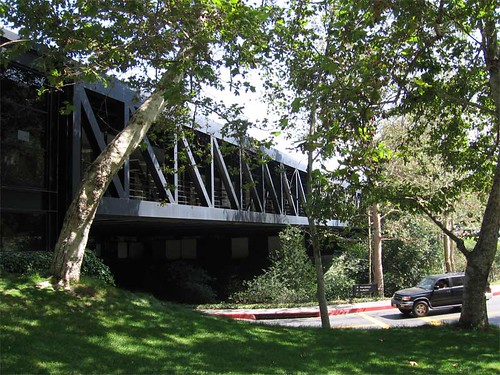
Completed in 1976, this incredible building designed by architect Craig Ellwood is described mostly using words like 'masterpiece' and 'iconic'. And those words are appropriate.
Here are some excellent images of its construction, showing the Hillside Campus building long, new and nude on its mountainous perch.
The ACCD Archive maintains a major collection of material related to the site, the building and its construction.
What was most affecting for me, however, was driving beyond suburbia through the lush, green hills of Pasadena and then being confronted/awed by the spectacle of all this glass and metal, hovering like it does over the hills and amongst the trees. And then driving underneath its roost and along its length to park.

A bit surreal, a bit sic-fi, the somatic reaction it elicits has seen the building feature in many films, including one of my all-time favourites Escape from New York (1981). See a comprehensive list of all the ACCD locations for this dystopian cult classic compiled here. Snake Pliskin, I heart you.
None of the many photos I took of the buildings exterior adequately captured it's effect.

Luckily Google is out there doing what it does, and you can drive up the hill and under the structure here with Google Street View.
Virtual Art Library Tourism!

Nestled in all that beautiful construction is the James Lemont Fogg Memorial Library and Art Center Archives. I park and bustle everyone out of the car (my wee children and Husbando sternly instructed to frolic on the grass outside).
Adding to the delight of the visit is the fact that it is the day of the Undergratuate Degree Show- and a flurry of activity has exploded on campus. It feels as if every well lit wall has been employed to great effect by the exhibiting student body. And members of this student body are literally running around the building in focused/frantic attempts to make it all right on the night. I love Grad Shows.

Oscars: Main reading room


With all my rummaging in the stacks, it looks like I left out a post on the spacious light-filled main reading room. With all the goods down below, up above and in archival fridges scattered around the site, I got a little swept away.
This more traditional public face of the library showcases handsome fixed wooden shelves. Devilish when trying to manage a shifting and ever-growing monograph collection, but oh-so-good looking.


It features beautiful vaulted ceilings and skylights in a room where tanks once lay in this ex-water treatment plant. Another great use of this once industrial space. An image of the room before the refit is on display in one of the nooks:


Oscars: Vital Stats

Institution : Margaret Herrick Library, Douglas Fairbanks Center for Motion Picture Study, Academy of Motion Picture Arts and Sciences

Holdings: 10 million photographs; 32,000 monographs; 2400 journals; 250,000+ clippings files. Not to mention their posters, oral histories, musical notation and recordings, scrapbooks, personal manuscripts/private papers of industry professionals and other ephemera. Like Oscar statues. Some excellent indexes/databases/directories to Academy (and therefore industry wide) activities and their Awards event.

Staff: 70+

Critical Systems: Voyager (Ex Libris), Inmagic

There is a great summary of this Library here at LibGig, a information industry professional networking website.

Oscars: Adios

Wow.
Linda's generosity in guiding me through the several floors and acres of stacks is a credit to her both professionally and physically. I was wiped out- but she did it all in heels without batting an eye.
This collection was truly distinctive. Enviably funded with collection and preservation imperatives embraced by it's governing body and industry, it stands as an unchallenged leader in holdings of primary material on its specialisation.
The articles and artifacts of this collection highlight a common blur/intersection explored on the ArtLibraryCrawl. Text as object, object as text. Resources with real weight and cultural heft.
The value in and challenges of the inherent physicality of this collection is true of many collections surrounding visual arts practice, and certainly make for interesting fodder on my mission of art library tourism.


I leave via the "Kirk Douglas Grand Stairway" supplied thoughtfully by Kirk and his lovely wife Anne, say farewell to Douglas Fairbanks, and am off, and away.

Oscars: Sheet music


When Linda describes the sheet music collection in tonnage, I think she may not be overstating the numbers.
The wide reaching collection includes music notation for every song that has won an Oscar plus every song that has been nominated. Shelved alphabetically, they make for pleasing displays both in and out of their handsome archive boxes.


Oscars: Colleen Moore Scrapbooks


Actress Colleen Moore dropped this collection off to Linda personally. Well into her seventies, she was still sporting the sharp cut she made classic.
I always referred to this hairstyle (which I have adopted a few times) as the Louise Brooks. Sorry Louise, it is now the Colleen Moore.


Oscars: Hayes / Breen Censorship files, continued

These files highlight the extraordinary reach of the code in the early days, and map social and cultural evolution as the restrictions lift later on the in the sixties.


The correspondence between censors and filmmakers was exhaustive.
Comprising mostly crinkly onionskin carbons, the documents are the copies maintained by the censors for their records. The studios would have received the original in this game of censorship vs entertainment/titillation/artistic freedom.

Scripts had to be signed off before production could begin.
The Office very specifically dissected the actions and implications of the characters.
My personal favorite is simple and to the point:
"…importantly there must be no leering on the part of Floyd or Lefty"
(what else did they think a pair named Floyd and Lefty were going to do?)


Later on, as restrictions relaxed, the process became simpler.
No longer was the censor involved at every level from conception, writing, through production and editing. Complete films could be presented and concepts judged in context.
Linda outlines swearing as a great barometer of the changing mores.
Initially out of the question, filmmakers were granted a token @#*!!.
Then 3, then 4. Arbitrary, but a historical and sociological reveal that makes these files very excellent.
In many ways the Code was an simply economic standard: the MPAA couldn't risk valuable film commodities being shunned by puritanical markets within the States, and propitious but possibly sensitive screens across Europe and the world.

Oscars: Hayes / Breen Censorship files

"Cabinet X"

These censorship files represent one of the Library's most heavily used collections.
Every film made between 1930 and 1968 need to go through the rigorous moral obstacle course that was required by the Motion Picture Production Code.
Enacted by the Hayes Office (after founder, censor and Prebestian elder William H Hayes), later known as the Breen Office (after first administrator Joseph Breen) the Code identified and enforced what was allowed upon the hallowed silver screen.