Showing posts with label archive. Show all posts

School of Visual Arts: SVA & Milton Glaser Archives

Graphic design. On paper.


School of Visual Arts Archive

The institutional SVA Archive was set up concurrently with the Milton Glaser Archive, so Beth and her colleague Zacahry Sachs are generally as busy as two archive/library staff can be. Which is, you know, pretty busy. They were also investigating new archival management systems such as CollectiveAccess  (I love that system), as well as preparing to move the physical collection, so I am pretty happy they took the time to meet with me. Full points and gold stars.

Getting into the physical archive was great. Beth had innovated, and made best use of a small and less than ideal space.
There is no formal climate control, but they have housed them uniquely.
Working with an awnings company, Beth helped create these canvas housings for the shelving units.


Rubber backed canvas and waterproof zips provide an environment within the room that is light and dust and waterproof.


School of Visual Arts: SVA & Milton Glaser Archives


Beth Kleber, chief archivist, has had an extraordinary role in the set up (from the ground up) of an institutional archive.
A librarian (with postgrad archive training via NYU's dynamite archive program) here in the SVA's Visual Arts Library for over 5 years, Beth returned from baby-making hiatus and was set to the task of archive genesis.

It was borne from the longterm friendship between SVA founder and chairman Silas Rhodes and legendary designer Milton Glaser (responsible for, among many other things the iconic I ♥ NY campaign and logo).
Mr Glaser wanted to create an archive of his work at the SVA. At this point there was no archive of any kind at SVA. While the school was figuring out where to put such a wonderful thing, Beth worked directly with Milton Glaser, in his studio.
This took a few years.


What an extraordinary boon for an archival collection. Beth worked through his effects, with him, to decide what to donate, and was able to speak with the creator himself on the significance of each item. Apparently no small task: Milton Glaser kept everything- every note, every napkin scrawled with ideas, plus all the original art and printed material. Beth gleefully referred to that time as her "Milton Glaser University" years. All info was dutifully databased as she went, but I am quite sure she herself is probably the most important Milton Glaser resource in the collection/basically anywhere.
As it turned out, almost all the material ended up at SVA. The Milton Glaser Archive, with its antecedent Milton Glaser Collection was soon fortified by several other significant collections, such as Chermayeff & Geismar Collection (a firm that pioneered the abstract corporate logo), and the Henry Wolf Collection. Many of the designers included have a history with the school, usually through their excellent teaching program.
See list of the Glaser Archive holdings here.


Fales Library and Special Collections

While the Fales holdings of literature and food are important and impressive, it is the other major collections: the Downtown Collection and the Riot Grrrl Collections that propelled me that day into the office of senior archivist Lisa Darms.

Part of the Downtown Collection stacks, in stark contrast to the more traditional literature collection on the far shelves.

Through the 'seventies the Fales was essentially a one-man show, a small, quiet, special collection attached to NYU's Bobst Library. Current director Marvin Taylor started the decidedly rowdier Downtown Collection in 1994.
I'd heard great things from Ken Soehner at the Met about Marvin's energy and passion for his role at the helm of this extraordinary repository.
Marvin was out when I was poking around the collection, but this micro interview gave me a teaspoon of the wit and the beard behind the Fales' program of highly networked contemporaneous collecting.

The Downtown Collection seeks to document the Downtown Scene of NYC in all its interdisciplinary iterations. The enormous living breathing archive of the arts of Downtown Manhattan is quite a brief. The Village, SoHo and The LES have been a magnet, a hive and home of the worlds artists for, well, forever. Archiving and preserving the various local histories of dance, performance, film art and anti-art, the Downtown collection is behemoth and unusually shaped.

"Magic Box"
Being the major repository for a diverse arts community equates to extraordinary holdings and an impressive generation of donations and acquisitions.
Bequests from writers, artists, collectives, performances spaces and performers of this locale results in an archive with a decidedly liberal definition of "document".
The shelves are crammed with objects of varying dimensions. We found a crocodile. Skateboards. Two filing cabinets are traditionally archived (cabinets themselves being the catalogued object).


While this special collection values the artifactuality of these objects, the focus is on formal research value (one of the catalogued filing-cabinet's surface is a palimpsest of graffiti, art and info, donated from the offices of Fashion Moda, the other cabinet housed Riot Grrrl Kathleen Hanna's personal archive).

And the research value is sky high. Sharing the shelves with all these beautiful and unconventional objects are the papers of Richard Hell, Gary Indiana, Lucy Lippard and David Wojnarowicz. Among many, many others.

There is 65,000 audiovisual elements in the Downtown Collection. All unique: documentation of performances of dance, and music, experimental films and elements that went into making those productions.
There is also a local cable network AV collection with elements numbering the thousands. An incredibly rich documentation of an era, donated directly to the Fales, that could be a stand-alone collection in itself.

And the collection has momentum.
As the downtown area gentrifies and develops, the Fales continues to (unfortunately, but gratefully) benefit from the urban shift in this once lower socioecononmic, culturally sensitive area.
Many collectives and artists simply cannot afford to live in Manhattan, or maintain the space required for their own studios and archives.
An all too familiar tune, even here across the pond.


NYU: Fales Library and Special Collections


The Fales Library and Special Collections is housed in this, the Elmer Holmes Bobst Library, a fearsome research temple in the Village.

The Cloisters: Deep Stacks


This second, deeper stack room of The Cloisters Library holds the monographs unconverted to LC, and the rest of the archival material.
This has resulted in a awesome salmagundi, the best kind of bits and pieces.
Museum administration papers, the personal papers of founder George Grey Barnard, early glass lantern slides of material held by the museum, collections of images of museum under construction, curators papers both internal and external, scholars papers. Bequests of dealers records (particularly those whose merchantry contributed to the Cloisters collection), a bequest from scholars of medieval architecture. Spools of reel to reel tape of classical music for piping through the museum halls, back when one used reel to reel technology to sidestep vinyl records skipping. Piles of loose maps in various states of repair and decay. Basically, this room is crammed with wonderful, ephemeral and very orderly treasure.


And the longest, most impressive compactus I've ever met.


The Cloisters: Deep Stacks


dOCUMENTA Archiv and Research Library


dOCUMENTA Archiv and Research Library: Artist Files


These artist files hold extensive info on local, German and international artists. The collection was started in the beginning of the 1960's and they contain press clippings, invites, gallery ephemera etc.

Artist file on the late Georg Meistermann


dOCUMENTA Archiv and Research Library: Media Archive


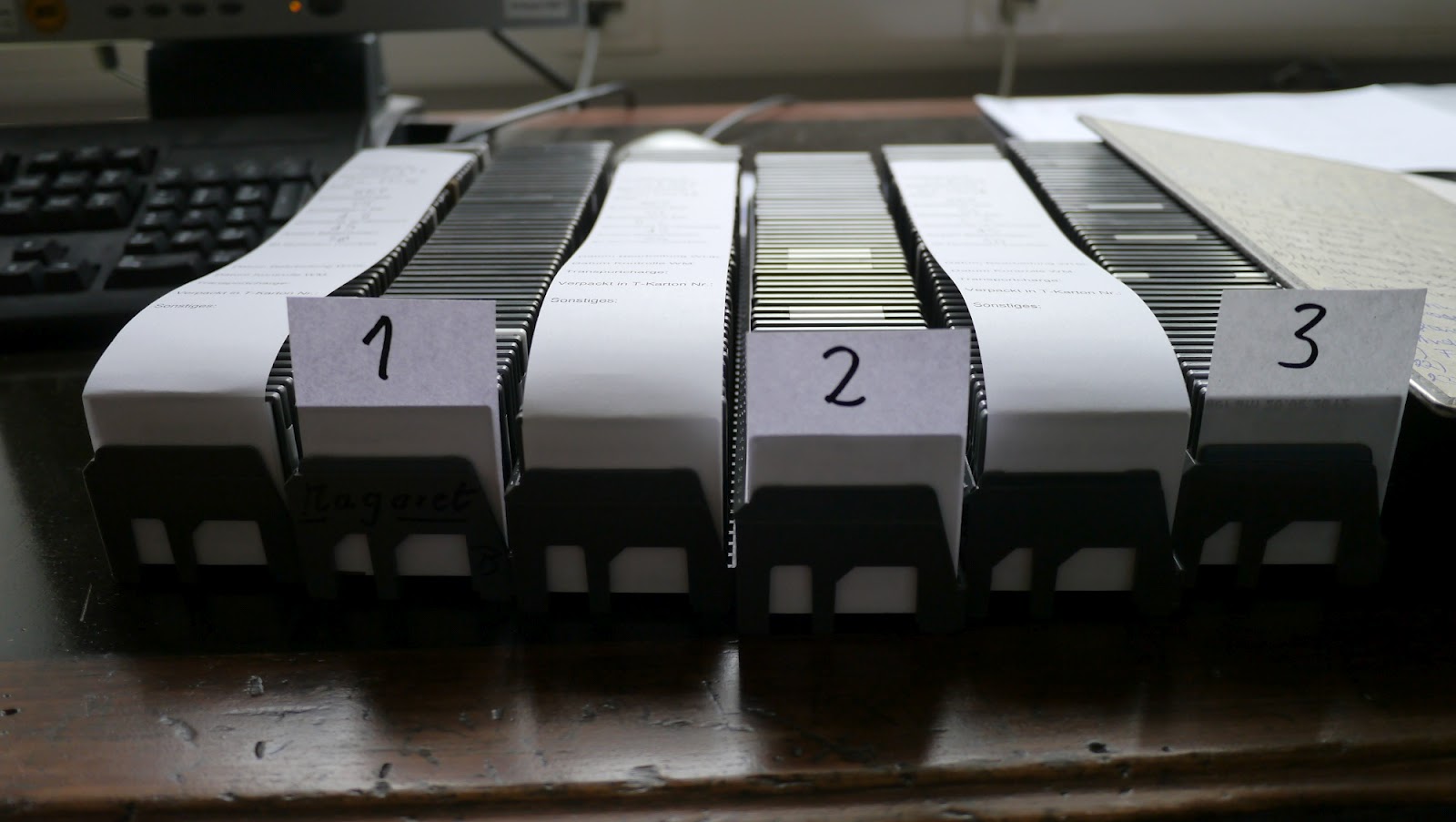
Here are some of the slides ready to be shipped off to their digitised future.
All artworks included in dOCUMENTA programs are photographed for posterity.
There is a slight race against time right now, as concern about ageing slides and fading colours mount. So goes the eternal search for the perfect preservation technique.


In the meantime, some copyright issues have of course raised their little heads.
This seems to be dealt with in an extremely well mannered way, with one off licensing fees paid through an agency. All participating artists and collectives now sign waivers to eliminate future issues.


Below are some slides that have already been digitised, safely mounted in a very awesome filing and viewing system. These files are jam packed with Very Important Artists who have shown in earlier dOCUMENTA. Seen here: Wassily Kandinsky.


dOCUMENTA Archive and Research Library


The dOCUMENTA Archiv is currently undertaking a massive digitisation project, and have converted to bytes all images from dOCUMENTA 1 through 5, and are currently tackling 6 (1977).
The job is not one for the lighthearted. The amount of data generated for and about these major events, held every five years, multiplies in each instance. Good luck, team.


dOCUMENTA Archiv


These delicious archive boxes house all the info gathered by the dOCUMENTA organisation and the (separate) dOCUMENTA Archive. They are arranged chronologically by exhibition, represented by the stencilled d6 on the bottom left of the box. These hold paper files, press clippings, invites and administrative notes for dOCUMENTA 6, held in 1977.


With Manfred Schneckenburger at the helm as Artistic Director, it was the last dOCUMENTA that founder Arnold Bode was involved in. Bode passed away 2 days after this dOCUMENTA closed. 
This particular file holds a number of Bode's writings, thoughts, and sketches for the event.


L.A. Louver: First Library on the Art Library Crawl


I just found this post hidden in my drafts! This Archive was the first visit on the Art Library Crawl project. I am pleased to show it the light, at last.


I was thrilled to visit L.A. Louver. This significant commercial gallery, founded in 1975, has wooed me from afar with its tantalising mailouts for some time from far across the pond.
I love the feel of the structure, designed by Frederick Fisher in 1997.


Its walls support an impressive program of contemporary local and international work, the gallery stable including David Hockney, Leon Kossoff, Alice Neel, Sean Scully, Tony Bevan and Fred Williams.

I meet the archivist Alice serendipitously in the goods lift [...seeing art with small children in strollers often affords you a look behind the scenes. One ends up in enormous elevators designed for the largest format artworks, which to me causes an enticing sense of shifted proportion]. Alice generously agrees to meet with me the next day (sans children) for a quick chat about her role at the gallery.


Here is Alice amongst the main archives. While I can sympathise with the sense of exposure experienced by an archivist trying to (neatly) manage her workload in full view of patrons, as a patron (and affirmed library stickybeak), I love the glimpse that this design provides into the inner workings of the organisation's information backbone.


Here it is peeking out -neatly- from behind the velvet rope in the upstairs exhibition space. It is shown here framed by the works of Rebecca Campbell.
The shelves on the right contain the physical files, publications and ephemera of the exhibition files, and the shelves on the left contain artist files. Digital archiving is done with Filemaker.


The gallery website provides easy access to their past exhibitions online under 'then', back to 2003. Alice is currently in the process of digitising and publishing the full back catalogue, encompassing the entire exhibition history since the gallery's establishment in 1975. Already the gallery's online presence is meaty. Current and future exhibitions are at 'NOW' and 'next'. These locations also contain generous links to respective current and upcoming shows for their represented artists at other galleries.


The gallery's programs and energetic record keeping has made its archives an important repository for curators and artists over the years.


Gallery Director Kimberly Davis filled me in while I photograph her with her monographs on contemporary artists [in her office here with works by Ben Jackel and Don Suggs].

She expressed pride in the gallery's library and archive. She explains that the organisation spends a lot of time, energy and resources to make it available- both internally and externally. They regularly accomodate a range of scholars and curators from around the world. This patronage reaches far beyond the artists they are involved with. Counting the monographs in her office (as well as co-Director Peter Goulds collection), the gallery maintains a reasonable general library. However, for the artists L.A. Louver represents -such as Hockney and Kossoff- their archive is almost a complete record of everything they have done, enabling a uniquely full understanding of their work. These artists frequently request from L.A. Louver's archive. In fact, they get requests for info from just about everyone [today they had a curator from Vasser in the gallery doing research].
While not an educational facility -they are foremost a working gallery- people respectful of this constitution will continue to reap the rewards of this fine fine-art resource.

Art Center College of Design: Archive


The ACCD Archive collects and preserves the historical documents of the school, its alumni and faculty, and its landmark site.
It houses a variety of material: the tree made publications of the institution, books, video, film, audio, photographs and events ephemera.

ACCD Library Director Betsy Galloway supported the relatively recent creation of the archive. With the impetus of a major anniversary of the school (75 years young), a grant was sought and won, with funds used to create the archive and arm it with archiving talent.
Archivist Robert (Bob) Dirig has since help transform the collection from the mildewed boxes of old to the well ordered universe that lay before me.

With a strong background in film preservation, Bob's current role provides a welcome opportunity to work with the various departments, pinning down all kinds of production for the records. He notes the necessity of proper archiving for an institution to really know itself, historically and contemporaneously. Here is a short interview with Bob where he shares his views on archiving, medium, technology and the like.


The space was filled with the customary (and for me, desirable) shelves of the aesthetically calming, repetitive forms of archive boxes in neutral
tones- great.


A handsome timeline displaying images of past Center Presidents collated from the photo archive by Bob himself- excellent. 


But what was truly fantastic for me was one of the jewels of their fine collection- the 1948 Ansel Adams portfolio.


The old library stamps spurred conversation on the chronological/institutional/operational and design issues library stamps can represent.
How different practices and paradigms can be easily read not just in the typography, typeset and ink of the stamp, but in the placement and spread of the marking.
Organisational name changes and library name changes have their effect, too. The Adams portfolio is stamped "Art Center School", a previous moniker.


I know many old National Art School Library books whose stamps tell tales of organisational tetris.
Here is a Flickr pool showing love for the library stamp. Go, stampers.

While at NAS I compiled a collection (of facsimilies) of the dozens of different donation/dedication exlibris designs I came across in the front of old tomes. I should pass them on to Elizabeth some day.