Showing posts with label Kassel. Show all posts

dOCUMENTA 13: Bibliophilia

Here are some panel details from aforementioned Mark Dion's commission for dOCUMENTA 13,  a hexagonal immersive display cabinet for the Schildbach Xylotheque in the Ottoneum.


dOCUMENTA13: Bibliophilia


This is the Schildbach Xylotheque (from the Greek xylon for wood and theque for repository).
These specimens were collected by naturalist Carl Schildbach in the late 18th century.
The 530 'books' in the collection are made from the wood, branches, twigs, flowers and leaves of 441 local tree species. They have been moulded and carved into monograph format, with the spine displaying the natural appearance of bark from trunk or branch.
Within is a diorama of the flowering and fruiting bodies of the species, and a written botanical description.

Mark Dion (American, b1961) was commissioned by dOCUMENTA13 to rehouse the Xylotheque for permanent exhibition in the Ottoneum (Kassel's museum of natural history, one of dOCUMENTA13's many venues). Known for his work exploring the aesthetic of the Wunderkabinetts/ cabinets of curiosity, as well as his appropriation of various archaeological and scientific methods, his work often investigates the exhibition of objects. Perfect, then, for this task.

Dion added six books to the Xylotheque, including one made from trees planted by Joseph Beuys in 1982 for dOCUMENTA 7, for the Land Art work 7000 Oaks.


dOCUMENTA Archiv and Research Library


An absolutely delicious green faux snakeskin archive box, found in the Media Archive at the dOCUMENTA Archiv and Research Library, in downtown Kassel

dOCUMENTA Archiv and Research Library: Artist Files


These artist files hold extensive info on local, German and international artists. The collection was started in the beginning of the 1960's and they contain press clippings, invites, gallery ephemera etc.

Artist file on the late Georg Meistermann


dOCUMENTA Archiv and Research Library: Media Archive


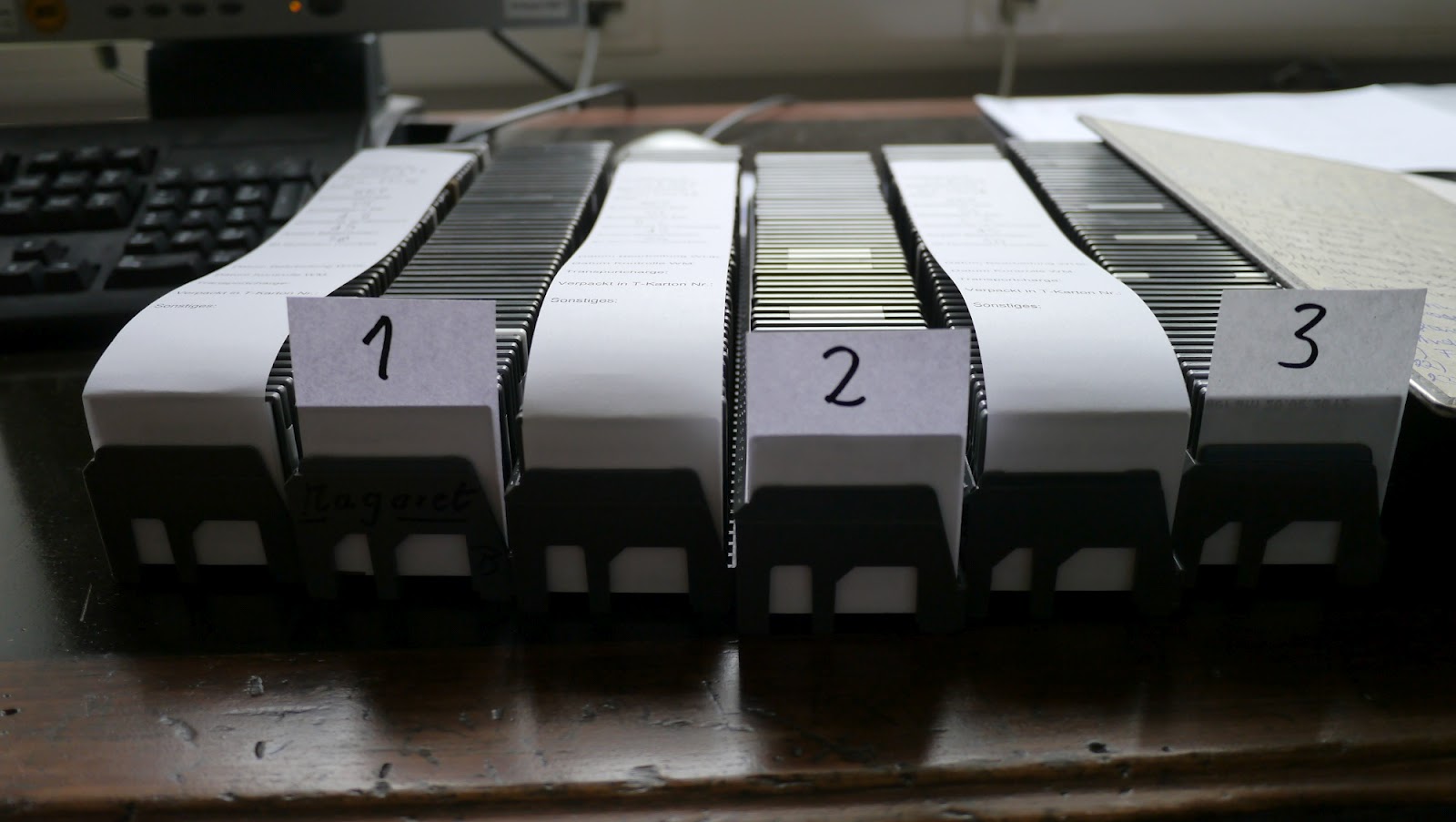
Here are some of the slides ready to be shipped off to their digitised future.
All artworks included in dOCUMENTA programs are photographed for posterity.
There is a slight race against time right now, as concern about ageing slides and fading colours mount. So goes the eternal search for the perfect preservation technique.


In the meantime, some copyright issues have of course raised their little heads.
This seems to be dealt with in an extremely well mannered way, with one off licensing fees paid through an agency. All participating artists and collectives now sign waivers to eliminate future issues.


Below are some slides that have already been digitised, safely mounted in a very awesome filing and viewing system. These files are jam packed with Very Important Artists who have shown in earlier dOCUMENTA. Seen here: Wassily Kandinsky.


dOCUMENTA Archive and Research Library


The dOCUMENTA Archiv is currently undertaking a massive digitisation project, and have converted to bytes all images from dOCUMENTA 1 through 5, and are currently tackling 6 (1977).
The job is not one for the lighthearted. The amount of data generated for and about these major events, held every five years, multiplies in each instance. Good luck, team.


dOCUMENTA Archive and Research Library: Vital Stats

Institution: dOCUMENTA Archive and Research Library, Kassel, Germany

Holdings: Library: 100 000 monographs and exhibition catalogues, 150 ongoing hardcopy journal subscriptions. File Archive: 2000 files, 250,000 newspaper clippings, 150,000 invitiations.
Media Archive: 25,000 slides, 3000 videos, 450 DVDs, 10,000 b/w photographs, 1000 ektachrome, 2000 artist portraits


Staff: 2 librarians (part time), Media archivist, Press File Archivist. Champions, all.


dOCUMENTA Archiv


These delicious archive boxes house all the info gathered by the dOCUMENTA organisation and the (separate) dOCUMENTA Archive. They are arranged chronologically by exhibition, represented by the stencilled d6 on the bottom left of the box. These hold paper files, press clippings, invites and administrative notes for dOCUMENTA 6, held in 1977.


With Manfred Schneckenburger at the helm as Artistic Director, it was the last dOCUMENTA that founder Arnold Bode was involved in. Bode passed away 2 days after this dOCUMENTA closed. 
This particular file holds a number of Bode's writings, thoughts, and sketches for the event.


dOCUMENTA Archive and Research Library: Journals


The dOCUMENTA Archive and Research Library currently maintains about 120 current hardcopy journal subscriptions. They have a few databases, but have not funnelled their relatively modest budget toward full text providers- their client base comes mostly from the Kunsthochschule (University School of Art), specialised researchers, and arts-orgs and kusthalles such as the Fridericianum who all have their own digital subscriptions.
The focus is very much on their specialised collection of the dOCUMENTA events and artists.
And look! Art & Australia has a display on their shelves.


dOCUMENTA Archive and Research Library: Journals


The Library does not bind its periodicals.
While there is a preservation loss with this practice, I do love being able to handle and view the magazine in its original form, as was intended.


And they do have these- by far my favourite journal boxes. Great for display of non-bound serials- a completely open front that doesn't affect receptacle shape thanks to the strong material, and a handy lip to stop them sliding back on shelf. Look at them go.


dOCUMENTA Archive and Research Library: Sol Lewitt carpet

The carpet in the dOCUMENTA Archive and Research Library was designed by Sol Lewitt, and has survived over twenty years of use and a library refurb too. It is very handsome.


dOCUMENTA Archive and Research Library: classifications and organisations


 Hubertus Gassner was director here at the dOCUMENTA Archive and Research Library for several years from 1989. Gassner is now director at the prestigious Kunsthalle in Hamburg.
Gassner, another art historian, is responsible for shaping the library and archive into its current model.

What was really interesting was the history of the development of the Library's unique classification system, through the various hands and minds of the Library's managers.

Classification system of the dOCUMENTA Archive and Research Library

It seems Dewey and LC never got a foothold in the specialised collections of Germany: certainly not the ones I have visited. The Kassel School of Art and the Bauhaus Archiv also have developed their own systems.


The monographs on artists remain in alphabetical arrangement.
A systematic subject division was devised by a director of the collection in the early eighties.


This was born a shelving arrangement with no operational catalogue.
In 1987 a formal catalogue was developed, and a digital library management system implemented in 1990. All acquisitions post 1990 are included in this LMS which exists now as Alephino a Aleph/ExLibis product.

A major retro cataloguing project has just received funding and a big green light, so tens of thousands of older titles will soon be incorporated into the catalogue proper. Very exciting!


Titles like this one. Early and rare catalogues of German and international artists are plentiful here on these shelves in the Kulturhaus. There is a huge amount of material like this in the collection that can  now be properly accessioned. The grant was received from a German scientific fund and will wage a  cataloguing team for 2 years.

dOCUMENTA Archive and Research Library Trolleys


No trolley portrait additions for my library trolleys series today.

However, I came across a librarian in her natural habitat browsing library trolley catalogues.
I was pleased as punch.

Sabine Franke brings me up to date with trolley technology.


Bucher und Prasentationswagens!

dOCUMENTA Archive and Research Library


The dOCUMENTA Archive and Research Library was founded in 1961.

It was an idea of Arnold Bode: founder of the dOCUMENTA exhibitions, artist, curator, art historian, furniture designer, architect, local paladin. A true "Tausendsassa": a german expression for a man of a thousand talents.
Bode, in fact, designed the Bauhausian building that houses the Art School Library [Kunsthochschule Kassel] I had visited earlier in the week.

Classic Bode


While Bode conceived the Archive, it was eventually opened by the City of Kassel, running parallel but separate to the dOCUMENTA organisation.
The collection was set up and run by Art Historian Lucy Von Wayer in rooms within the Murhard Library (a central city library now integrated into the Kassel University Library network )
Lucy may have had a hard time at the role. Without any formal library training, and very much NOT Arnold Bode's choice for the role (he had planned his dOCUMENTA co-curator Werner Haftmann take the job), she nonetheless pioneered the collection that survives today.


The collection moved into the current premises in the Kulturhaus (directly behind the Fridericianum) in 1989, which houses a collection of arts organisations including the dOCUMENTA organisation proper.

dOCUMENTA Archive and Research Library

One of the first things I noticed upon entry to the dOCUMENTA Archive and Research Library is the sheer volume of material successfully stored in this space. 
There are over 100 000 items in the collection, and they are all present on this floor to ceiling shelving. 
With no lending and no offsite stacks, everything you need is right here. Or maybe, right up there near the ceiling. There have been no ladder fatalities to date.


dOCUMENTA Archive and Research Library


A highlight of my personal dOCUMENTA (13) was spending time with Petra Hinck, Associate Director of the dOCUMENTA Archive and Library.


She generously spent time showing me the collection and projects of her institution during the opening week of dOCUMETA (13), no doubt the busiest week of her year.
I found in Petra a keen humour and a fellow art library tourist- she and some colleagues last year spent time in New York visiting major institutional bibliotheques including the Frick, the Met, MOMA, and NYU's Fales collection- so we were able to share experiences and some genuine thrall at the resources of these eminent institutions.


dOCUMENTA(13): Bibliophilia and Libricide


Libricide remembered in the work of Michael Rakowitz.

What Dust Will Rise? (2012)

"Special Pride" in the destruction of a Jewish Library in Poland

"For us it is a matter of special pride to destroy the Talmudic Library which has been known as the greatest in Poland...we threw out of the building the great Talmudic Library and carted it to market. There we set fire to the books. The fire lasted for twenty hours. The Jews of Lublin were assembled around and cried bitterly. The cries almost silenced us. Then we summoned a military band, and joyful shouts of the soldiers silenced the sounds of Jewish cries."
           - Frankfurter Zeitung, March 28 1941


Libricide and other less violent forms of "library loss" further explored in this UNESCO published treatise:
'Lost Memory -  Libraries And Archives Destroyed In The Twentieth Century' 

dOCUMENTA(13): Bibliophilia and Libricide


More Archive/Library/Book works at dOCUMENTA (13):

Michael Rakowitz What dust will rise? (2012)

Commissioned and produced for dOCUMENTA(13)


From the exhibit info:

What Dust Will Rise? recreates selections from the library of the Landgraves of Hesse-Kassel that were destroyed in a fire in the Fridericianum during a bombing by the British Royal Airforce on September 9 1941.With the help of stone carvers from Afganistan, Michael Rakowitz remade these lost volumes out of travertine quarried in the hills of Bamiyan, where two monumental sixth-century sandstone Buddhas were dynamited by the Taliban. The undertaking conjures tombstones and recalls the tradition of stone books serving as surrogates for the illiterate. One sculpture has been donated to the National Museum of Kabul, which was also severely damaged under the Taliban.